PicoScope 7 Software
Available on Windows, Mac and Linux

A to Z of PC oscilloscopes
Everything you need to know about PC oscilloscopes from Advanced Triggers to Zooming.

A to Z of Data Loggers
Everything you need to know about PC-based data loggers from Alarms to Zooming.
Application Notes
Details of some of the many applications for Pico data logger and oscilloscope products.

How do I measure...?
Find out how you can measure using Pico products

Videos
Showing you how to get the most out of PicoScope oscilloscope software.

Documentation
Up-to-date versions of the documentation supplied with your products in PDF format.

Educational Experiments
Our library of science experiments suitable for use with oscilloscope and data logging products.

PicoApps
Want to share hints, tips and code with other developers? Show your Pico-based products to the world.
Newsletter
Archive of our monthly Test and Measurement Newsletters.

PicoScope® 2000 Series
Like a benchtop oscilloscope, only smaller and better
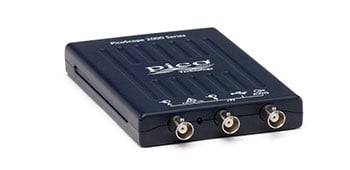
| Model | PicoScope | ||||||
|---|---|---|---|---|---|---|---|
| Bandwidth | 10 MHz | 25 MHz | 50 MHz | 70 MHz | 100 MHz | ||
| 2 channel | 2204A | 2205A | 2206B | 2207B | 2208B | ||
| 4 channel | 2405A | 2406B | 2407B | 2408B | |||
| 2 channel MSO | 2205A MSO | 2206B MSO | 2207B MSO | 2208B MSO | |||
| Oscilloscope — vertical (analog inputs) | |||||||
|---|---|---|---|---|---|---|---|
| Bandwidth | 10 MHz | 25 MHz | 50 MHz | 70 MHz | 100 MHz | ||
| Rise time (calculated) | 35 ns | 14 ns | 7 ns | 5 ns | 3.5 ns | ||
| Vertical resolution | 8 bits | ||||||
| Enhanced vertical resolution | Up to 12 bits | ||||||
| Input ranges | ±50 mV, ±100 mV, ±200 mV, ±500 mV, ±1 V, ±2 V, ±5 V, ±10 V, ±20 V | ±20 mV, ±50 mV, ±100 mV, ±200 mV, ±500 mV, ±1 V, ±2 V, ±5 V, ±10 V, ±20 V | |||||
| Input sensitivity (10 vertical divisions) |
10 mV/div to 4 V/div | 4 mV/div to 4 V/div | |||||
| Input coupling | AC / DC | ||||||
| Input connector | BNC(f) | ||||||
| Input characteristics | 1 MΩ ± 1% ∥ 15 pF ± 2 pF | 1 MΩ ± 1% ∥ 16 pF ± 1 pF | |||||
| Analog offset range (vertical position adjustment) |
None | ±250 mV (20 mV to 200 mV ranges) ±2.5 V (500 mV to 2 V ranges) ±20 V (5 V to 20 V ranges) |
|||||
| Analog offset control accuracy | N/A | ±1% of offset setting, additional to basic DC accuracy | |||||
| DC accuracy | ±3% of full scale ±200 μV | ||||||
| Overvoltage protection | ±100 V (DC + AC peak) | ||||||
| Oscilloscope — vertical (digital inputs, MSOs only) | |||||||
|---|---|---|---|---|---|---|---|
| Input channels | 16 channels (2 ports of 8 channels each) | ||||||
| Input connectors | 2.54 mm pitch, 10 x 2 way connector | ||||||
| Maximum input frequency | 100 MHz (200 Mb/s) | ||||||
| Minimum detectable pulse width | 5 ns | ||||||
| Input impedance | 200 kΩ ±2% ∥ 8 pF ±2 pF | ||||||
| Input dynamic range | ±20 V | ||||||
| Digital threshold range | ±5 V | ||||||
| Overvoltage protection | ±50 V | ||||||
| Threshold grouping | Two independent threshold controls: Port 0: D0 to D7, Port 1: D8 to D15 | ||||||
| Threshold selection | TTL, CMOS, ECL, PECL, user-defined | ||||||
| Port threshold accuracy | ±350 mV (inclusive of hysteresis) | ||||||
| Hysteresis | < ±250 mV | ||||||
| Minimum input voltage swing | 500 mV pk-pk | ||||||
| Channel-to-channel skew | 2 ns typical | ||||||
| Minimum input slew rate | 10 V/µs | ||||||
| Horizontal | |||||||
|---|---|---|---|---|---|---|---|
| Maximum sampling rate (real-time)* | 100 MS/s | 200 MS/s | 500 MS/s | 1 GS/s | |||
| Equivalent sampling rate (ETS mode) | 2 GS/s | 4 GS/s | 5 GS/s | 10 GS/s | |||
| Maximum sampling rate (USB streaming) | 1 MS/s | 1 MS/s | 9.6 MS/s | ||||
| Shortest timebase | 10 ns/div | 5 ns/div | 2 ns/div | 1 ns/div | |||
| Longest timebase | 5000 s/div (approx 14 hours per waveform in chart recorder view) | ||||||
| Buffer memory (block mode)* | 8 kS | 16 kS | 48 kS | 32 MS | 64 MS | 128 MS | |
| Buffer memory (USB streaming mode) | 100 MS (shared between active channels) | ||||||
| Waveform buffers | 10 000 | ||||||
| Maximum waveforms per second | 2000 | 80 000 | |||||
| Initial timebase accuracy | ±100 ppm | ±50 ppm | |||||
| Timebase drift | ±5 ppm / year | ||||||
| Sample jitter | 30 ps RMS typical | 20 ps RMS typical | 3 ps RMS typical | ||||
| ADC sampling | Simultaneous | ||||||
* Maximum sampling rate and buffer memory are shared between active channels. On MSO models each group of 8 inputs counts as a channel. Maximum sampling rate on MSO digital channels is 500 MS/s.
| Dynamic performance (typical) | |||||||
|---|---|---|---|---|---|---|---|
| Crosstalk (full bandwidth, equal ranges) | Better than 200:1 | Better than 300:1 | |||||
| Harmonic distortion | < –50 dB at 100 kHz, full-scale input, typical | ||||||
| SFDR (100 kHz, full-scale input, typical) | > 52 dB | ±20 mV range: > 44 dB ±50 mV range and higher: > 52 dB |
|||||
| Noise | < 150 μV RMS (±50 mV range) |
< 220 μV RMS (±20 mV range) |
< 300 μV RMS (±20 mV range) |
||||
| Bandwidth flatness | (+0.3 dB, –3 dB) from DC to full bandwidth | ||||||
| Triggering | |||||||
|---|---|---|---|---|---|---|---|
| Sources | Ch A, Ch B, Ch C, Ch D. Any MSO digital channel | ||||||
| Trigger modes | None, auto, repeat, single | None, auto, repeat, single, rapid (segmented memory) | |||||
| Advanced triggers | Edge, window, pulse width, window pulse width, dropout, window dropout, interval, logic |
Edge, window, pulse width, window pulse width, dropout, window dropout, interval, runt pulse, logic |
|||||
| Trigger types, ETS | Rising or falling edge | Rising or falling edge (available on Ch A only) | |||||
| Trigger sensitivity, real-time | Digital triggering provides 1 LSB accuracy up to full bandwidth | ||||||
| Trigger sensitivity, ETS | 10 mV p-p, typical, at full bandwidth | ||||||
| Maximum pre-trigger capture | 100% of capture size | ||||||
| Maximum post-trigger delay | 4 billion samples | ||||||
| Trigger rearm time in rapid trigger mode | N/A | < 2 μs on fastest timebase |
< 1 μs on fastest timebase | ||||
| Max. waveforms in rapid trigger mode | N/A | 96 | 10 000 | ||||
| Function generator | |||||||
|---|---|---|---|---|---|---|---|
| Standard output signals | Sine, square, triangle, DC voltage, ramp, sinc, Gaussian, half-sine | ||||||
| Pseudorandom output signals | None | White noise, PRBS | |||||
| Standard signal frequency | DC to 100 kHz | DC to 1 MHz | |||||
| Sweep modes | Up, down, dual with selectable start/stop frequencies and increments | ||||||
| Triggering | None | Free-run or up to 1 billion waveform cycles or frequency sweeps. Triggered from scope trigger or manually. |
|||||
| Output frequency accuracy | Oscilloscope timebase accuracy ± output frequency resolution | ||||||
| Output frequency resolution | < 0.02 Hz | < 0.01 Hz | |||||
| Output voltage range | ±2 V | ||||||
| Output adjustments | Any amplitude and offset within ±2 V range | ||||||
| Amplitude flatness (typical) | < 1 dB to 100 kHz | < 0.5 dB to 1 MHz | |||||
| DC accuracy | ±1% of full scale | ||||||
| SFDR (typical) | > 55 dB at 1 kHz full-scale sine wave | > 60 dB at 10 kHz full-scale sine wave | |||||
| Output characteristics | Front panel BNC, 600 Ω output impedance | ||||||
| Overvoltage protection | ±20 V | ||||||
| Arbitrary waveform generator | |||||||
|---|---|---|---|---|---|---|---|
| Update rate | 1.548 MHz | 20 MHz | |||||
| Buffer size | 4 kS | 8 kS | 32 kS | ||||
| Resolution | 12 bits | ||||||
| Bandwidth | > 100 kHz | > 1 MHz | |||||
| Rise time (10% to 90%) | < 2 μs | < 120 ns | |||||
| Spectrum analyzer | |||||||
|---|---|---|---|---|---|---|---|
| Frequency range | DC to analog bandwidth of oscilloscope | ||||||
| Display modes | Magnitude, average, peak hold | ||||||
| Windowing functions | Rectangular, Gaussian, triangular, Blackman, Blackman-Harris, Hamming, Hann, flat-top | ||||||
| Number of FFT points | Selectable from 128 to half available buffer memory in powers of 2, up to a maximum of 1 048 576 points | ||||||
| Math channels and Software filters | |||||||
|---|---|---|---|---|---|---|---|
| Functions | −x, x+y, x−y, x*y, x/y, x^y, sqrt, exp, ln, log, abs, norm, sign, sin, cos, tan, arcsin, arccos, arctan, sinh, cosh, tanh, freq, derivative, integral, min, max, average, peak, delay, duty | ||||||
| Software filters | Highpass, lowpass, bandpass, bandstop | ||||||
| Operands | A, B (input channels), C, D (input channels, 4-channel models only), T (time), reference waveforms, constants, pi, digital channels (MSO models only) | ||||||
| Automatic measurements | |||||||
|---|---|---|---|---|---|---|---|
| Scope mode | AC RMS, true RMS, frequency, cycle time, duty cycle, DC average, falling rate, rising rate, low pulse width, high pulse width, fall time, rise time, minimum, maximum, peak to peak | ||||||
| Spectrum mode | Frequency at peak, amplitude at peak, THD dB, SNR, SINAD, SFDR, total power, average amplitude at peak, THD %, THD+N, IMD |
||||||
| Statistics | Minimum, maximum, average and standard deviation | ||||||
| Serial decoding | |||||||
|---|---|---|---|---|---|---|---|
| Protocols | 1-Wire, ARINC 429, CAN, CAN FD, DALI, DCC, DMX512, FlexRay, Ethernet 10Base-T, USB 1.1, I²C, I²S, LIN, Manchester, MODBUS, PS/2, SPI, SENT, UART/RS-232 (subject to bandwidth and sampling rate of chosen oscilloscope model) | ||||||
| Mask limit testing | |||||||
|---|---|---|---|---|---|---|---|
| Mask generation | Numeric (automatic) or Graphical (manual) | ||||||
| Statistics | Pass/fail, failure count, total count | ||||||
| Available actions on mask fail | Beep, play sound, stop capture, save waveform, trigger signal generator / AWG, run executable | ||||||
| Display | |||||||
|---|---|---|---|---|---|---|---|
| Interpolation | Linear or sin(x)/x | ||||||
| Persistence modes | Digital color, analog intensity, custom, fast or none | ||||||
| SDK / API details and specifications for customers writing their own software | |||||||
|---|---|---|---|---|---|---|---|
| Supplied drivers | 32 and 64-bit drivers for Windows 7, 8 and 10 Linux drivers macOS drivers |
||||||
| Example code | C, C#, Excel VBA, VB.NET, LabVIEW, MATLAB | ||||||
| Maximum USB streaming sampling rate* | 1 MS/s | 5 MS/s | 31 MS/s | ||||
| Buffer memory in USB streaming mode* | Limited only by PC | ||||||
| Segmented memory buffers* | N/A | 96 | 128 000 | 256 000 | 512 000 | ||
* These specifications apply when using the drivers / writing your own software. Refer to Horizontal section above when using PicoScope software
| Software | ||
|---|---|---|
| Windows software | PicoScope for Windows PicoSDK Software development kit (SDK) Windows 7, 8 or 10 recommended (read more) |
|
| macOS software | PicoScope for macOS Software development kit (SDK) OS versions: see release notes |
|
| Linux software | PicoScope for Linux Software development kit (SDK) See Linux Software & Drivers for details of supported distributions |
|
| Languages | Chinese (simplified), Chinese (traditional), Czech, Danish, Dutch, English, Finnish, French, German, Greek, Hungarian, Italian, Japanese, Korean, Norwegian, Polish, Portuguese, Romanian, Russian, Spanish, Swedish, Turkish | |
| General | |||||||
|---|---|---|---|---|---|---|---|
| Package contents | PicoScope 2000 Series oscilloscope 2 or 4 switchable 10:1/1:1 oscilloscope probes (except for PicoScope 2204A / 2205A when purchased without probes) TA136 digital cable (MSOs only) 2 × TA139 pack of 10 logic test clips (MSOs only) USB cable Quick start guide |
||||||
| PC connectivity | USB 2.0 (USB 3.0/3.1 compatible). | ||||||
| Power requirements | Powered from USB port | ||||||
| Dimensions (including connectors and feet) |
142 x 92 x 18.8 mm | 130 x 104 x 18.8 mm | |||||
| Weight | < 0.2 kg (7 oz) | ||||||
| Temperature range, operating | 0 °C to 50 °C | ||||||
| Temperature range, operating, for stated accuracy |
15 °C to 30 °C | ||||||
| Temperature range, storage | –20 °C to +60 °C | ||||||
| Humidity range, operating | 5% to 80% RH non-condensing | ||||||
| Humidity range, storage | 5% to 95% RH non-condensing | ||||||
| Altitude range | up to 2000 m | ||||||
| Pollution degree | 2 | ||||||
| Safety approvals | Designed to EN 61010-1:2010 | ||||||
| Environmental approvals | RoHS, WEEE | ||||||
| EMC approvals | Tested to meet EN61326-1:2013 and FCC Part 15 Subpart B | ||||||
| Languages supported | Simplified Chinese, Czech, Danish, Dutch, English, Finnish, French, German, Greek, Hungarian, Italian, Japanese, Korean, Norwegian, Polish, Portuguese, Romanian, Russian, Spanish, Swedish, Turkish | ||||||
| Warranty | 5 years | ||||||